Water damage restoration is the whole recovery after water gets where it shouldn’t — from the first emergency extraction through structural drying and back to a rebuild-ready home. It doesn’t matter whether the water came from a burst supply line, a failed water heater, a roof leak, or a river: the job is to get the water out, dry the structure to standard, stop secondary damage before it starts, and restore what was lost. We cover homes and businesses across Hattiesburg and the Pine Belt.
Every Water Loss Is a Race Against Time
Water doesn’t sit still. In the first hours it wicks up drywall, saturates insulation, seeps under flooring, and soaks into the subfloor and framing. Left alone, the damage compounds: swollen materials, delamination, staining, and — under EPA guidance — mold that can begin growing within 24–48 hours.[1] That’s why restoration is measured in how fast the recovery starts, not how big the leak was. The same volume of water does far more damage over three days than it does in three hours.
From First Call to Rebuild-Ready
A complete restoration runs as one continuous process, not a series of disconnected visits:
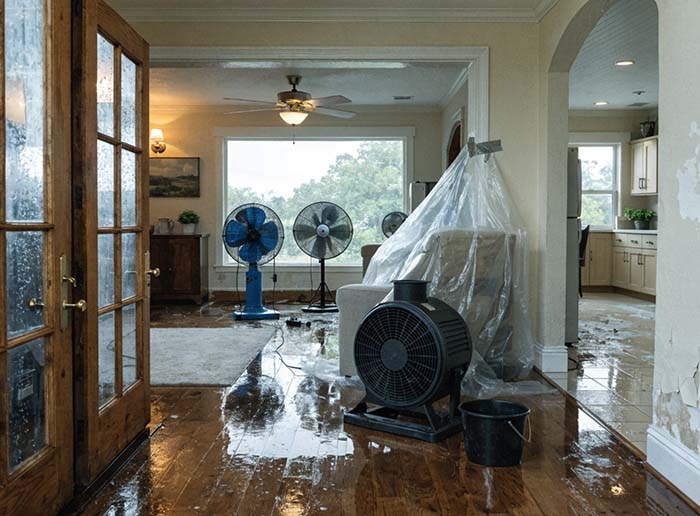
- Assessment and extraction. We locate the moisture — including what’s hidden behind walls and under floors with meters — and pull standing water out fast.
- Controlled demolition. Materials too saturated to save (soaked carpet pad, swollen baseboard, ruined drywall) come out so the structure can dry.
- Structural drying. Commercial dehumidifiers and air movers bring wood, framing, and remaining materials back to a documented dry standard, verified with daily moisture readings rather than a fixed calendar.
- Cleaning and antimicrobial treatment. Affected surfaces are cleaned and treated to prevent microbial growth.
- Restoration and repair. Drywall, flooring, trim, and paint go back so the space is whole again.
The physical work is guided by the IICRC S500 standard of care for water damage restoration.[2]
Clean, Gray, or Black — the Water Category Sets the Scope
Not all water is equal, and the IICRC S500 standard grades it into three categories that determine how the job is handled:[2]
| Category | What it is | Typical source |
|---|---|---|
| Category 1 | Clean water | Broken supply line, tub or sink overflow |
| Category 2 | Gray water | Dishwasher or washing-machine overflow, sump-pump failure |
| Category 3 | Black water | Sewage backup, rising river or flood water |
A clean-water loss caught early is a very different job than contaminated water that sat for days — and Category 1 water left standing degrades toward Category 2 and 3 as time passes, which is one more reason speed matters.
What Changes the Size of the Job
Two water losses in the same neighborhood can need very different scopes. The honest drivers are structural, not a flat rate:
- How long the water sat before drying started — the single biggest factor.
- The water category — clean versus contaminated changes what can be saved and what must be removed.
- How far it spread — square footage reached, and whether it migrated between floors or into wall cavities.
- The materials involved — hardwood, engineered flooring, plaster, and cabinetry each dry and respond differently.
We scope from what the moisture meters and the damage actually show, document it for your insurer, and walk you through the plan before work starts. If you have standing water or a fresh leak right now, request help or call — a real person answers, day or night.
Sources
- EPA — A Brief Guide to Mold, Moisture and Your Home
- ANSI/IICRC S500 — Standard for Professional Water Damage Restoration
Frequently Asked Questions
The full lifecycle: emergency water extraction, removing unsalvageable materials, structural drying with commercial dehumidifiers and air movers, antimicrobial treatment, and repairs that put the home back to rebuild-ready. It's the whole recovery, not just pumping out water.
As soon as possible — water wicks into drywall, insulation, and subfloor within hours, and under EPA guidance mold can begin growing within 24–48 hours. The sooner extraction and drying start, the less there is to tear out and rebuild.
Yes. The IICRC S500 standard grades water as Category 1 (clean, from a supply line), Category 2 (gray, from an appliance), or Category 3 (black, from sewage or flooding). Each requires a different scope, and clean water left standing can degrade to a worse category over time.
It depends on how long the material was wet and the water category. Many materials can be dried in place when we reach them early; others have to be removed. We document moisture readings so removal decisions are based on evidence, not guesswork.
Sudden, accidental water damage (burst pipes, appliance failures) is usually covered; damage from long-term leaks or rising floodwater is handled differently. We document everything your adjuster needs and help you through the claim from first call to final walkthrough.